Recession fears grow as rising prices hit spending
- By --
- Thursday, 12 May, 2022

The UK could be heading for a recession, analysts have warned, after the economy shrank during March as the rising cost of living hit households.
Higher prices are "really beginning to bite", the Office for National Statistics said, as it revealed the economy contracted by 0.1% in March.
It said people were spending less in shops and cutting down on car journeys due to high fuel prices.
The impact of higher energy bills in April has also yet to be seen.
Many price rises are just starting to hit households now and last week the Bank of England forecast that inflation - the rate at which prices rise - could reach more than 10% by the end of the year.
The Bank said has warned the UK faces a "sharp economic slowdown", with prices rising at their fastest rate for 30 years, driven by soaring fuel, food and energy costs.
Although the economy contracted in March, it grew by 0.8% overall in the first three months of the year as hospitality and travel industries recovering from coronavirus pandemic restrictions.
However, all of that economic growth happened in January, before the war in Ukraine and before households began to feel the pinch of higher prices.
Paul Dales, chief UK economist at Capital Economics, said the latest figures "suggest the economy had less momentum than we thought even before the full hit from the cost of living crisis has been felt".
He added that the risk of recession - defined as the economy getting smaller for two consecutive quarters - "has just risen".
Darren Morgan, director of economic statistics at the ONS, told the BBC that people had already started spending less in shops and were cutting down on car journeys due to the high cost of fuel at the pumps, which has been driven by the war in Ukraine pushing up oil prices.
Mr Morgan said trading in the retail sector had fallen "well below expectations" in March, with people cutting spending on "big ticket, non-essential items".
"You can see the cost of living really beginning to bite," he added.
- Why are prices rising so quickly?
- What is GDP and how does it affect me?
"The other industry we saw very much struggling is the motor trade industry," he said.
The Society of Motor Manufacturers and Traders has said March marked the "weakest" for new car registrations since 1998, as supply chain problems continue to hamper carmakers.
We'll take any growth we can get right now, and on the face of it 0.8% growth in the economy during the first three months of the year is good by any normal standard and better than most of the comparable G7 major economies, some of which are already contracting. It confirms full recovery from the economic losses of the pandemic, though at a slower pace compared to the rest of those G7 countries.
But this looks like being old news already, before the cost of living crisis exacerbated by events in Ukraine, tripped up growth. The evidence of the impact of a squeezed economy hit by high prices is already visible in the first quarter's monthly breakdowns. All the growth happened in January, with a flat February and a small contraction in March.
Economists fear the economy could be contracting right now, though some of that may be down to an extra bank holiday. With taxes, interest rates, and inflation all hitting disposable income at the same time, the fear is that January could be as good as it gets for the UK economy in 2022.
Mr Morgan said a survey by the ONS of 40,000 businesses found over half had seen an increase in the price of wholesale materials and goods, but fewer than half of those firms were passing the costs on.
"They are absorbing those rises and you do have to question how sustainable that is on an ongoing basis," he said.
Many businesses expect the price of goods to increase further, and "their big concern is the energy prices," Mr Morgan added.
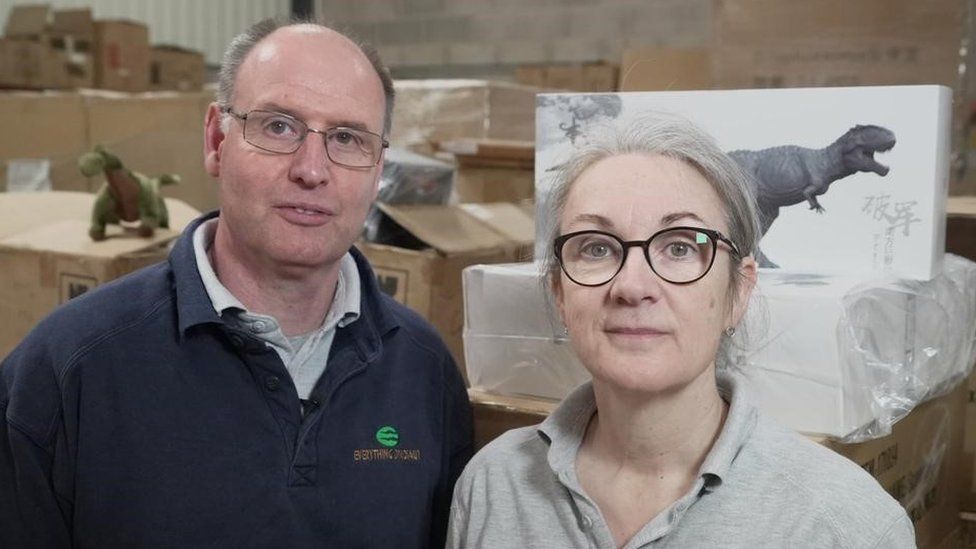
Mike Whalley and Sue Judd say small businesses are facing multiple challenges
Mike Whalley and Sue Judd, who own specialist model and toy shop Everything Dinosaur, said their running costs had increased "astronomically".
"It's taking twice as long to get goods as it used to and it's costing twice as much to actually get them here," Miss Judd told the BBC.
The pair, from Middlewich in Cheshire, have been forced to pass on some of the higher costs on to customers through higher product prices.
Mr Whalley said it was also more expensive and more time-consuming to export to Europe now following Brexit.
"We're being attacked from all sides. It's a challenging environment," he added.
Windfall tax
Chancellor Rishi Sunak told the BBC he was "ready to do more", but did not commit to further action on tackling the rising cost of living.
He insisted the UK economy remained "resilient" and was growing faster over the last three months compared to other countries with large economies.
The chancellor would not say whether a recession was likely in the coming months, but did admit that the "global economy is facing inflationary pressures", as a result of the war in Ukraine.
The latest GDP (Gross Domestic Product) figure saw renewed calls for a windfall tax on big oil and gas companies to help tackle the rising costs of living.
The government's current policy is not to impose one over fears the tax could deter investment in new oil and gas fields and green technologies.
Mr Sunak told the BBC he was not "naturally attracted to a windfall tax", but admitted he could see that big energy companies were making significant profits.
He said that he wanted to see firms make investments in the UK, but if that did not happen then "no option was off the table".
But Labour's Lisa Nandy, shadow secretary of state for Levelling Up, said a windfall tax was "an absolute no brainer" in order to "get money back in people's pockets now".
"Businesses are struggling, shops are boarded up, people simply don't have money to spend," she told the BBC, as she called for an emergency Budget to help people with cost of living.
The CBI business group said businesses and households were "feeling the pinch".
"The economy barely kept its head above the water during a volatile start to the year, but times look set to get that bit tougher," said Rain Newton-Smith, CBI chief economist.
Related News

.jpg)