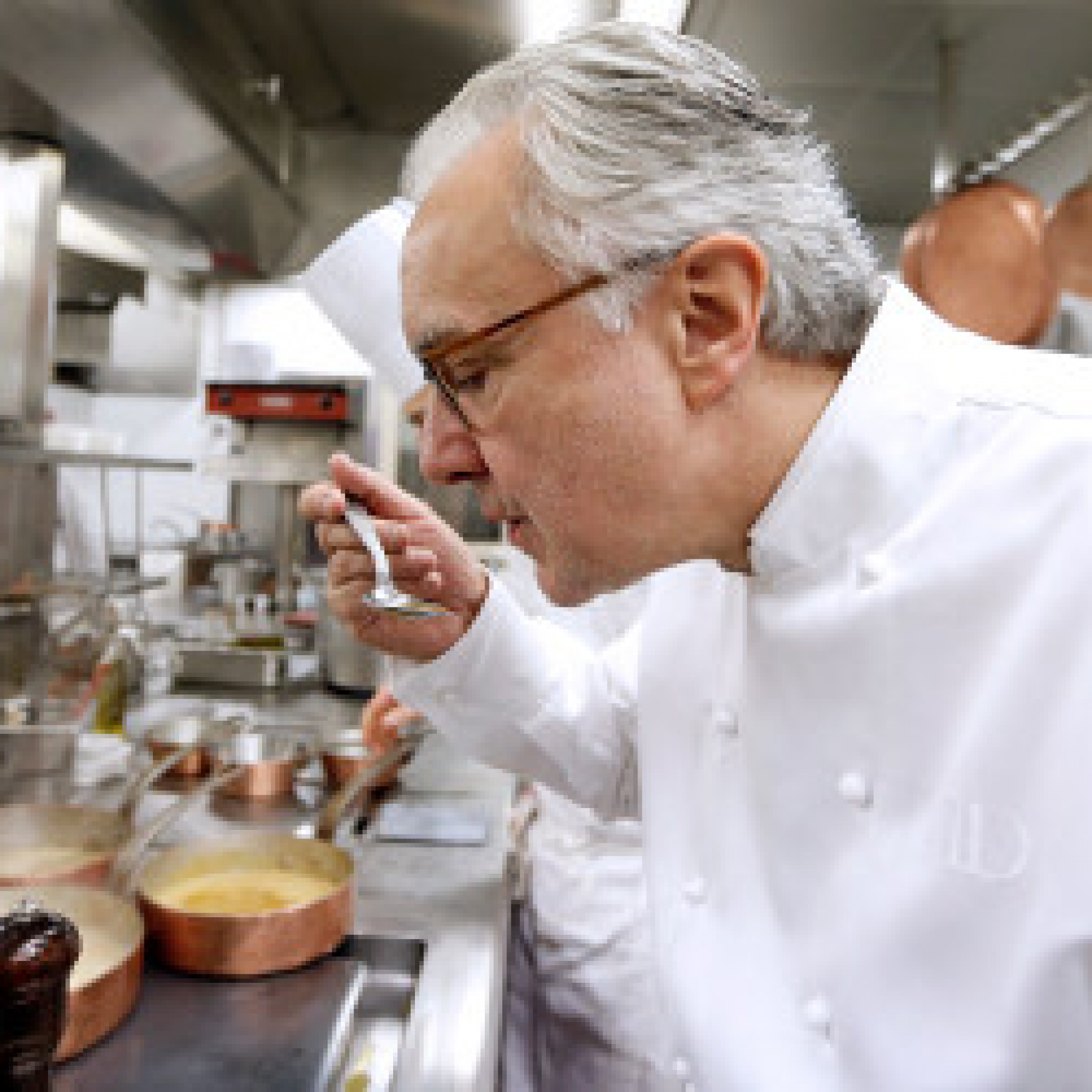
Maryann Tebben, author of Savoir-Faire: A History of Food in France, expands on the notion of a changing consumer, reflecting on how "they hear about it, they're reading about it, they're careful about the ecological footprint that they have, and they're more savvy than their parents or grandparents were about what food does for the environment."
When I think of French cuisine, plant-based cooking isn't the first thing that comes to mind. I think of meat, of Toulouse sausage, foie gras and calf brains. But, Ducasse points out, the growing emphasis on plant-based dishes didn't happen overnight; in recent years, vegetable-forward menus have been growing in the nation's top kitchens. And at Ducasse's restaurants, this focus goes back even further.
In 1987, he introduced plant-based menu Jardins de Provence to his three-Michelin-starred Le Louis XV restaurant in Monaco. Now, "30-40% of clients choose this 100% vegetarian menu," he explained.
Patrick Rambourg, a researcher specialising in French gastronomy and the author of Histoire de la cuisine et de la gastronomie françaises(History of French cuisine and gastronomy),has also been observing the transition to more sustainable cuisine in recent years. He agrees that France is in the midst of its next culinary evolution; and in his view, it wasn't catalysed by the pandemic. Instead, the movement has been slow and profound, he believes, growing due to an interplay between changing consumer demands and the eagerness of chefs to embrace the challenge of transforming vegetables into the star of a dish.
"The chefs are aware of a changing consumer that cares about where products come from. There are also people that want to eat high-end cuisine, gastronomy, but don't want to eat something unhealthy," he said. "There's a change in consciousness around cuisine. Kitchens don't have a choice but to adapt."
However it has come about, Ducasse is embracing the shift toward sustainable, vegetable-forward cuisine. In September, Naturaliste will transform into Sapid, a more permanent plant-based restaurant centred around conviviality on Rue Paradis in Paris's 10th arrondissement. It will feature a refectory-setup with communal tables, encouraging the social contact that people lacked during the past year.
Back at Aux Lyonnais, the maitre d' reappeared and placed two cardboard boxes on the table. I peeked inside. The dishes – roasted cabbage with avocado and smoked eel, and braised seasonal vegetables with sauteed mushrooms and quinoa – were the creations of young Peruvian chef Marvic Medina Matos, who has worked in the kitchens of three Michelin-starred Alain Ducasse au Plaza Athénée and Le Meurice Alain Ducasse.
Her dishes emphasise local produce and sustainability. "We work with respect to the seasons, and our menu changes according to the season," she told me. "I love putting the producers and ingredients forward."
Ducasse frames this next re-evolution of French cuisine as "local in production, global in the vision" with careful attention to the quality of ingredients, recalling Unesco's insistence on "the balance between human beings and the products of nature".
Human beings, however, are not as malleable as farm-grown asparagus or the country's hundreds of varieties of cheese. Evolution is shaped as much by resistance as by change, and some are in no hurry to abandon the generations-old rituals that define the Gallic art of eating.
France's cultural rituals have endured wars and revolutions. Ultimately, amid a year of stay-at-home orders and delivery-bound gastronomy, have the French changed their habits?
Ducasse looked down at his glass. "They've kept the bad habits," he said with a grin, taking another sip of sparkling wine.