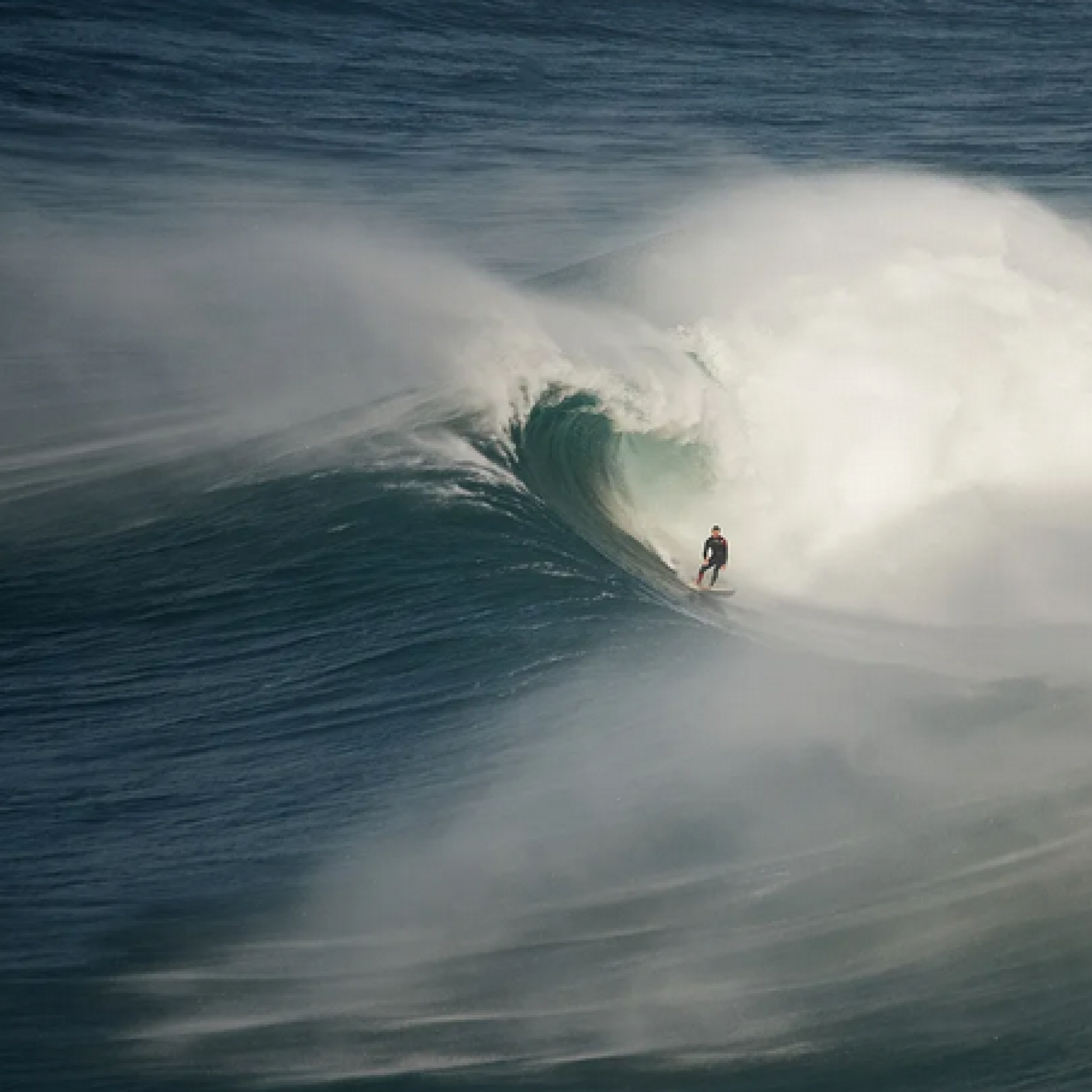
As the waves at Nazaré are more dangerous than any other surfing spot in the world, according to Von Rupp, these feats have only been made possible thanks to the establishment of the most stringent safety regime in big wave surfing history.
As well as the jet ski driver, who deposits the surfer on the wave, teams authorised to surf at Nazaré during a big swell must also include a spotter with a radio who keeps the driver informed on the surfer's location. "When you're in the white water, you don't know where anything is, you're just trying to survive," explained Salvador, who was put in charge of safety when McNamara landed in Portugal in 2010. There is also a second rescuer on a jet ski, and on big days a third.
Even then, the reality is that you can die, says Joana Andrade, the only Portuguese woman to surf the big waves at Nazaré. She prepared for eight months before her first attempt in 2013, a process that involved physical and spiritual training such as visualisation and breathing techniques. "You can have the physical body super well prepared but it's your mind that's going to save you if things go wrong," she explained. According to Von Rupp, some surfers meditate on their own drowning. "You have to be prepared not to panic if you're about to pass out, because that's when you open your mouth and let all your oxygen out. Your best chance of survival is keeping calm."
If the worst happens, responsibility shifts to the first jet ski driver. For Von Rupp and Andrade, this is Sergio Cosme, who has become known as "the guardian angel of Nazaré". "If you practise something 100 times, it becomes automatic," he told me. "In that moment, there are so many concerns in your head and in the case of safety, you have to be able to do things automatically and minimise the time of all the procedures because you only have seconds to do them."
But years of training doesn't guarantee a successful rescue, something Cosme struggles to talk about. Last year, his friend, Portuguese big wave surfer Alex Botelho, was knocked unconscious between the waves and stopped breathing for 10 minutes before being rescued by his partner Hugo Vau and resuscitated on the beach. "One day, the worst could happen, and it will be really hard to handle that," Cosme said.
Andrade believes it is worth the risks. "When the jet ski driver says, I'm going to put you on this wave, there are so many monkeys in my mind. I feel I can't do it, it's a mix of fear and adrenaline," she said. "But when he releases the cable, it's a feeling of freedom, understanding and peace. Although it's super fast, it feels like an eternity. You learn what it really feels like to be in the present, which is very important especially in these times."
You learn what it really feels like to be in the present, which is very important especially in these times
Before Nazaré tamed its gigantic waves, Von Rupp's generation of Portuguese surfers had to travel to the other side of the world – most often to Hawaii – to get close to that feeling. Now the epicentre of big wave surfing is an hour from his house. "To be part of that history in the making is amazing," he enthused. "It's also become a much safer sport, which has called in talented young Portuguese surfers to pursue careers in big wave surfing."
Nazaré locals now talk about big wave surfing like Christ; there's a before and an after. Before 2010, the population barely expanded beyond its 15,000 inhabitants in winter. Since the fort was converted into a museum about the waves in 2014, around one million tourists have visited, with 350,000 in 2019 alone. Winters are sometimes busier than summers, and business owners often approach Salvador to thank him for everything he and his colleagues have done for the town.
He's now working with the city hall on a project to expand on that impact, which will help students pursue careers in sectors linked to big wave surfing, including photography, driving and being a spotter.
Unlike at other big wave surfing hotspots, there have been no deaths at Nazaré so far. Cosme's hope is that as the location grows in popularity, safety measures will continue to be strengthened.
As the mist started to roll in and the colours of the sea and the lighthouse faded, a slight wind picked up the sand and it became easier to picture Nazaré with a big swell on the horizon. The world's bravest surfers will be back this year to try their luck at tackling the world's biggest wave.