Drivers pay £100 to fill tank for first time as petrol prices soar
- By --
- Thursday, 09 Jun, 2022

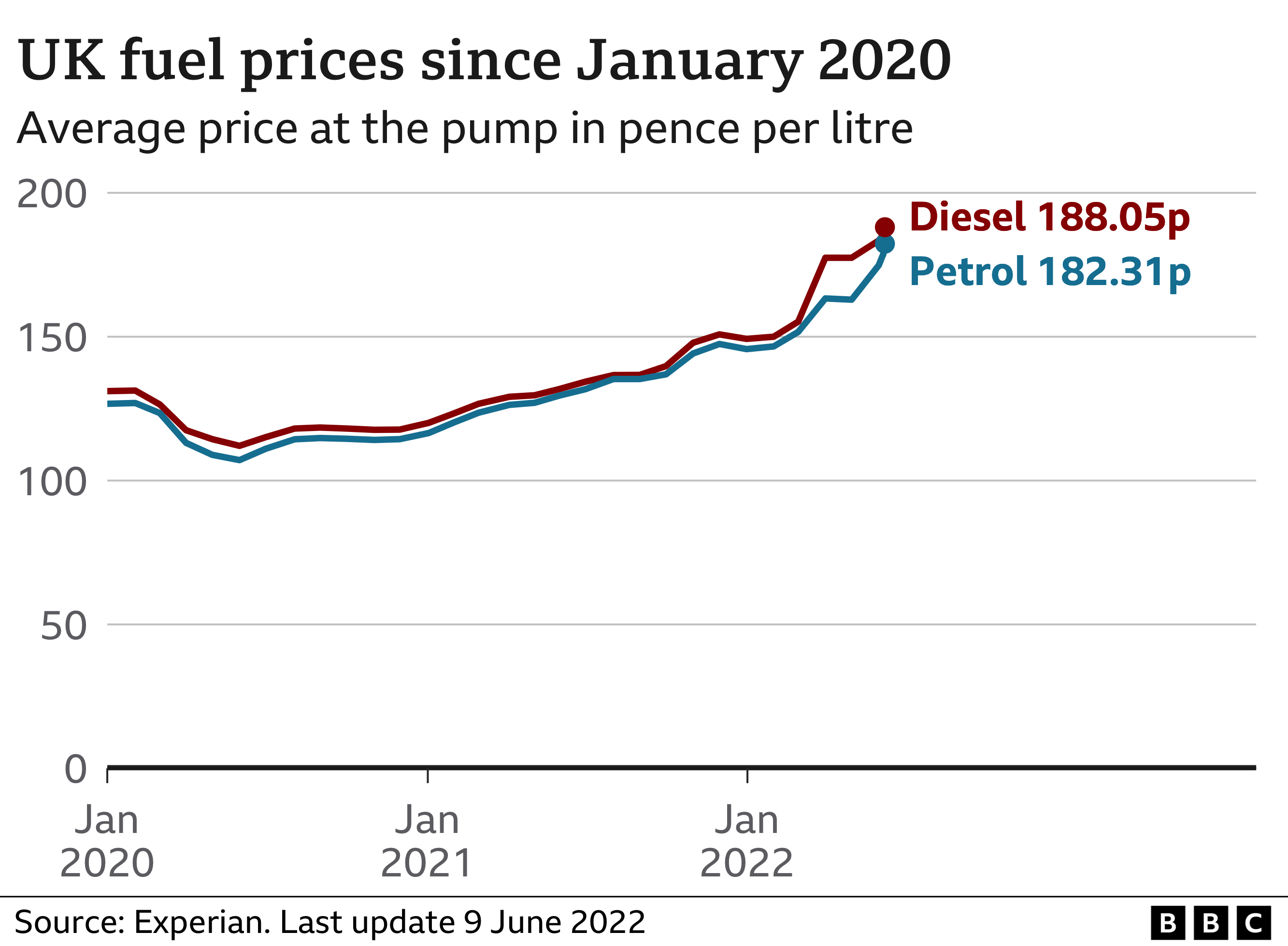
The cost of filling an average family car with petrol has hit £100 for the first time as fuel prices keep rising.
The RAC motoring group called it "a truly dark day" as the cost of filling a 55-litre tank with petrol reached £100.27 and £103.43 for diesel.
Soaring fuel prices have been driven by the war in Ukraine and moves to reduce Europe's dependence on Russian oil.
There are also concerns petrol retailers are not passing on a recent cut in fuel duty to consumers.
It adds to the growing pressure on household budgets, with energy bills and food prices also now at multi-year highs.
The RAC's fuel spokesman Simon Williams said: "While fuel prices have been setting new records on a daily basis, households up and down the country may never have expected to see the cost of filling an average-sized family car reach three figures."
He urged the government to offer more financial support to drivers, including a cut in VAT on fuel.
On Wednesday, rival motoring organisation the AA accused the RAC of adding to the problem with "speculation" that prices could climb as high as £2 a litre soon.
But Mr Williams rejected the criticism, telling the BBC his forecasts did not affect "what retailers do".
It comes as some UK forecourts are already selling petrol above £2 a litre, according to price comparison website PetrolPrices.
- Petrol prices see biggest daily jump in 17 years
- Service station defends £2 per litre fuel costs
- Why is petrol so expensive?
On Wednesday, the highest price was found to be 202.9p a litre at BP sites on the A1 near Sunderland, the M4 near Chippenham in Wiltshire and the M6 near Burton-in-Kendal, Cumbria.
The RAC said the wholesale price of petrol - the price at which supermarkets and independent forecourts buy it at - had actually dropped by 5p since 1 June, when it was £1.55 a litre, to £1.50 on Wednesday.
But the motoring group said it took time for a drop in the wholesale price to lead to falls at the pumps due to the way retailers buy fuel in advance.
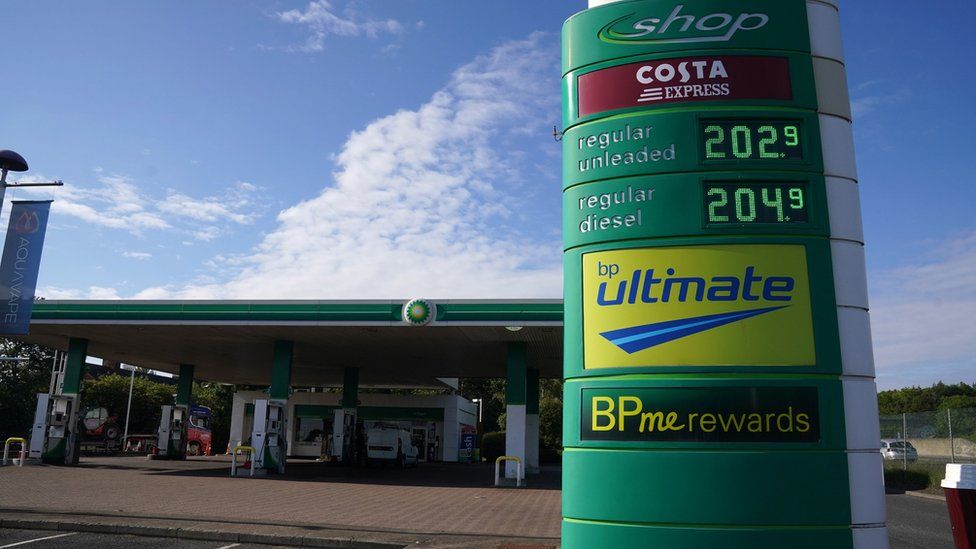 Motorists at the BP garage at Washington services on the A1(M) on Wednesday were paying more than £2 a litre
Ewan, 31, needs a car to get to work in centre of Aberdeen, otherwise it's a 1.5 hour bus journey. But he told the BBC he is now paying up to £90 to fill a tank and the petrol expenses provided by his employer no longer cover the cost.
The civil servant, who lives alone, said it was just one more thing pushing up his cost of living and on his current salary he is "barely" getting by.
"I used to be able to save about £200 a month but now I am dipping into savings," he said. "It makes me quite stressed out as that money is supposed to be safety net and I am eating into it."
The RAC's Mr Williams urged more support for drivers on low incomes, adding that the higher fuel prices went, the more the Treasury took in VAT receipts, at about 30p on every litre sold. This compares with 25p before Russia invaded Ukraine.
"On top of this the government is still collecting 53p fuel duty from every litre," Mr Williams added.
"March's 5p fuel duty cut now looks paltry as wholesale petrol costs have already increased by five-times that amount since March," he said.
The AA called on the government to cut fuel duty by 10p per litre immediately and introduce a "fuel price stabiliser", which would reduce fuel duty when petrol prices go up and increase it when they drop.
The government has so far ruled out cutting VAT, arguing that any increases in receipts it gets from higher fuel prices will be largely offset by reduced household spending and VAT on other items.

It announced a 5p a litre cut to fuel duty in March to help reduce costs for motorists - although ministers and motoring groups have raised concerns that not all retailers are passing the cut on.
A government source told the BBC a plan to name and shame petrol stations that failed to do so was "still in the works".
The Competition and Markets Authority said that if it found sufficient evidence the 5p fuel duty cut had not been passed on to drivers, then it would launch an investigation that could lead to fines for offending retailers.
'Not profiteering'
Lisa Stevenson, who owns Tolladine service station near Worcester, told the BBC her prices per litre - at 197.9p for unleaded and 194.9p for diesel - reflected volatile wholesale prices driven by the Ukraine war.
She said customers were now buying less fuel because of the cost: "A delivery of fuel would previously have lasted me a week to 10 days, now its 2-3 weeks."
Alasdair Locke, chairman of Motor Fuel Group, the UK's largest independent forecourt operator, told the BBC's Today programme that his business had passed on the 5p duty cut to consumers "immediately".
"It would be easy if there was evidence we're just profiteering but there is no evidence of that, in fact rather the opposite. Our margins are under pressure, along with everyone else's."
He said that if the business cut its margins further, it would not be able to invest in future projects like the rollout of electric vehicle charging points.
Related News

.jpg)